

Biden and Benedict
Leadership is also knowing when to quit

Before we turn to today’s topic of how the late Pope Benedict XVI may have become a trailblazer for President Biden, we need to retrace some steps.
In my previous newsletter I argued that President Biden’s bet on the Lord Almighty remaining wherever He is and not meddling in partisan politics likely achieved the opposite of what the Democratic candidate for the presidency had intended. Instead of showing resolve, leadership, and wisdom in decisive moments, Mr. Biden publicly bringing up the Lord Almighty at a crucial moment showed the world a man desperate for hints about the right path to follow. To be sure, on the surface the message was: I can handle this by myself, only direct divine intervention could change my mind.
However, Mr. Biden gave away much of his inner struggle on how to come to a sound decision by asserting to know God’s next move. I am not saying that he was consciously trying to be more prescient than God, but claiming as he did during the ABC interview that “the Lord Almighty’s not coming down” is more than rhetorical deception. It is a sort of reverse plea that He might do just that and relieve the President of the burden to reach an admittedly very difficult decision.
I am quite certain that the phrase “the Lord Almighty’s not coming down” will forever be attached to Joe Biden’s name and reprinted in countless history books. Academics will debate the deeper meaning of Mr. Biden’s assertion as a further sign of a growing secular understanding of supernatural powers relegated to the mere therapeutic and practical realms of human life. God is quite alright, we might collectively agree in our world made of machines and memes, but He had better remain “up there” – or wherever, unless summoned to “come down” to settle weighty issues. God is supposed to function much like the world we have constructed around us, that is, at our service and not we at His. God should be Mighty perhaps, but not Almighty – if you care for a theory of secularization in a nutshell.
President Biden may have done us a service in that regard. He may have inadvertently (again) shown us the deeper fissures in American public discourse and indeed the country’s soul. This is a topic we will have to come back to more than once, but for now it is a starting point for making the case that President Biden should choose retirement over running again.
Joseph Robinette Biden Jr., the 46th President of the United States of America and only the second Catholic to serve in that office, should look to Joseph Alois Ratzinger, known also as Pope Benedict XVI (1927-2022), for inspiration and guidance.
The message is straightforward and simple, from Benedict to Biden, from Joseph to Joseph: “Retirement is a blessing. None of us are irreplaceable. Quitting when ahead is wise.”
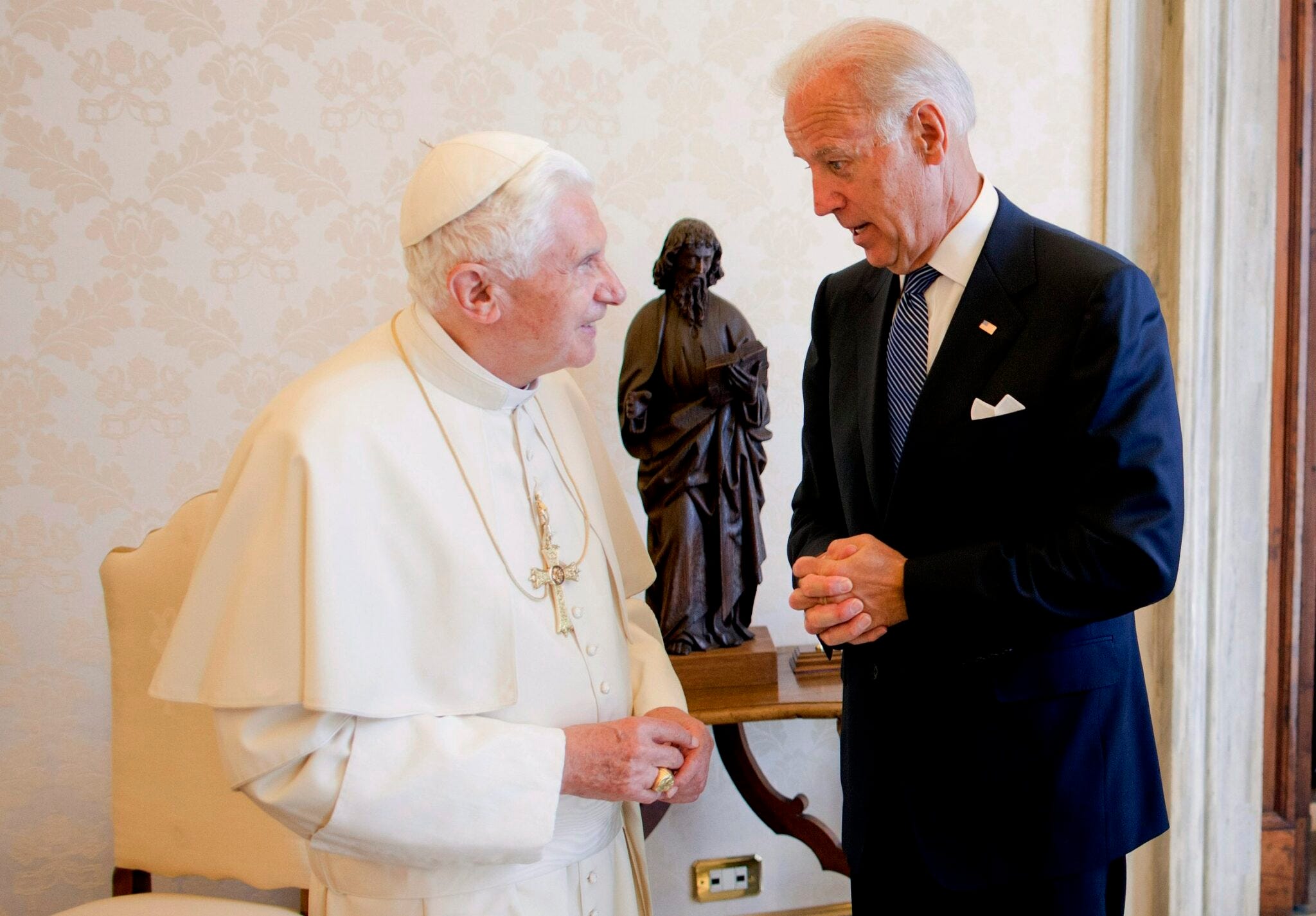
Pope Benedict XVI meets with U.S. Vice President Joe Biden at the Vatican in 2011 (CNS photo/Chuck Kennedy)
Of course, Benedict XVI never said those words. But everything he did say and do points to such a conclusion. Joseph Ratzinger was a humble man and blessed with a superb intellect. He was elected pope in 2005. On February 11, 2013 he announced his retirement as of February 28, 2013, catching most everyone by surprise. Popes as a rule do not retire, they die in office. The last pope to retire was Gregory XII in 1415.
Now, of course, presidents are not popes, although the latter are also heads of state. Popes may face various factions within the church but never an organized party. Once elected, they will never have to run for reelection. Popes are elected by peers, the cardinals, for a life term and in that sense resemble the members of the U.S. Supreme Court, the country’s third branch of government. The papacy, however, is an old monarchy and not a liberal democracy with its checks and balances.
Yet, the remarkable thing about Benedict’s courageous and unprecedented act in modern times was the reason he gave for his retirement from high office. He simply cited his “deteriorating strength and the physical and mental demands of the papacy.” He did not mention any specific ailment, but announced his decision at a time when he was still in control of his admirable cognitive abilities. Benedict XVI, pope emeritus, would live another nine years, passing away on December 31, 2022.
The President’s insistence on “finishing the job” runs counter to the spirit of his namesake whom he had met at the Vatican when he was Vice President in 2011. But maybe it is the destiny of Joseph R. Biden Jr., a Catholic and a man of faith, to look to Joseph A. Ratzinger for answers on how to bow out gracefully. God does not need to “come down” and settle the matter. Rather, the country and the world need to see that the transition of power in the United States is handled in a responsible manner. That takes wisdom, courage, and humility. Benedict had all those qualities and Biden was elected to the presidency in 2020 because many Americans believed he had them, too. The time has come for him to show us that he still has them and that he can muster them when far-reaching decisions need to be made. The U.S. commander-in-chief is called upon to serve the country and, as Pope Benedict has shown, that may well entail knowing when to stop serving.